

100 Things Every Presenter Needs to Know About People
Excerpted from 100 Things Every Presenter Needs to Know About People by Susan Weinschenk, Ph.D. Copyright © 2012. Used with permission of Pearson Education, Inc. and New Riders.
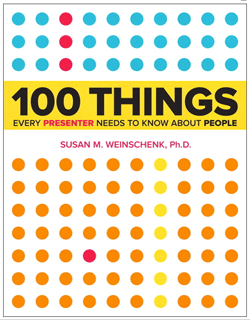
In addition to the HTML version of the excerpt below, you can also download the excerpt as a PDF that retains the full design of the printed book.
HOW TO GRAB AND HOLD PEOPLE’S ATTENTION
I have a recurring nightmare that goes like this: I am in a room giving a presentation. I feel passionately about the topic, and I know that I’ve put together a great presentation. But as the presentation moves along, I start losing control over the group. I notice that a few people aren’t listening to me. They are having their own conversation in the corner of the room. Then the inattention expands. More and more people stop listening and start talking to each other. Eventually I end up shouting over the conversations to try to be heard. People start leaving the room. No one is listening. I wake up suddenly in a panic and am very grateful to realize it was just a bad dream.
Luckily this nightmare has never become reality for me when I speak, but the fact that it is a recurring nightmare is a sign that losing the audience’s attention is something I’m anxious about.
Being able to grab and hold the attention of your audience is the sign of a great presenter. In this chapter we look at what psychology can tell us about how to do just that.
SUSTAINED ATTENTION LASTS ABOUT 10 MINUTES
Imagine you’re in a meeting and someone is presenting sales figures for the last quarter. How long can she hold your attention? If the topic is of interest to you and she is a good presenter, you can focus on the presentation for 7 to 10 minutes at most. If you’re not interested in the topic or the presenter is particularly boring, then you’ll lose interest much faster—possibly you’ll tune out within 7 seconds instead of minutes.
If people have a short break, then they can start over with another 7- to 10-minute period, but 7 to 10 minutes is the longest block of time they will pay attention to any one presentation.
Why Ignite! and Pecha Kucha are So Popular
If you’ve ever been to an “Ignite!” or Pecha Kucha presentation “jam,” you would likely agree that the 7-to-10-minute rule holds. These are meetings in which presenters come together to give short presentations in a very structured format. For an Ignite session, each presenter has 5 minutes to present 20 slides, or 15 seconds each. The slides are automatically advanced, so speakers have to live by the rules. Pecha Kucha presentations are similar; they have 20 slides that display for 20 seconds each. At these events, there is a succession of presentations by different speakers. I recently attended an Ignite session that went for 1.5 hours and had 15 different speakers. One reason why Ignite and Pecha Kucha sessions work well is that each presentation is under the 7-minute mark. When you get a new presenter and new topic every 5 minutes, it is easier to pay attention.
Build In Transitions and Mini-Breaks
A typical presentation is longer than 7 to 10 minutes. Presentations are often an hour long. This means you have to find ways to make changes at least every 7 minutes in order to get people to pay attention. It’s easy, as the presenter, to forget that your audience’s attention may be waning. As the presenter, you are having a very different experience than your audience: You have adrenaline flowing because you are on stage, you are in the throes of a performance, and you are physically moving. The members of your audience, on the other hand, are sitting in chairs, and their minds are easily wandering.
6 ways to create mini-breaks
In order to keep attention, you have to introduce some kind of change at least every 7 minutes. There are many ways to do this, and they can be small and subtle. Here are some ideas:
- Have a mini-break. If your session is longer than 60 minutes, you need to have some kind of break. This doesn’t have to be a long, 20-minute break. You can use a 5-minute stretch break too.
- Do something interactive. In my talks, I build in small exercises that can be done no matter how many people I’m presenting to. For example, during one of my presentations, I show a picture of an old-fashioned faucet with two handles, one for hot water and one for cold water. I ask the audience to write down which way they would turn the handles to get lukewarm water to come out of the faucet. Then we go through all the possibilities (there are four ways to turn the handles), and I ask for a show of hands for each method. I use the results to introduce the next topic, which is about mental models.
- Ask the audience a question. If you take a minute to ask the audience a question, that will serve as a break. If it’s a large group, you can ask questions that require only a show of hands (“How many of you have…”).
- Move to a different position. Rather than pacing around the front of the room or on the stage, stay in one area for a few minutes and then walk to a different place and speak from there. You can do this more often than every 7 minutes, as long as you are not continuously moving around (which makes you seem nervous).
- Move on to a different topic. Stop and say, “Now, I want to talk about something that is very different.”
- Tell a story. Stories grab attention instantly. Sprinkle interesting stories throughout your presentation. Make sure the stories are short and relevant to the topic at hand.
THE UNCONSCIOUS DIRECTS ATTENTION
Imagine you’re walking down a path in the woods when you see a snake on the ground. You freeze and jump backwards. Your heart races. You’re ready to run away. But wait, it’s not a snake. It’s just a stick. You calm down and keep walking on the path. You noticed the stick, and even responded to it, in a largely unconscious way.
Sometimes you’re aware of your conscious attention, but often what you pay attention to is directed by your unconscious.
People Can’t Resist Paying Attention to Food, Sex, and Danger
Have you ever wondered why traffic always slows when people are driving by an accident? Do you moan about the fact that people are attracted by the gruesome, and yet find that you glance over too as you drive by? Well, it’s not really your fault that you (and everybody else) can’t resist looking at scenes of danger. It’s your old brain telling you to PAY ATTENTION.
People Have Three Brains, Not One
In Neuro Web Design: What Makes Them Click, I talk about the idea that we really don’t have one brain, we have three. The new brain is the conscious, reasoning, logical brain that we think we know best; the mid-brain is the part that processes emotions; and the old brain is the part that is most interested in your survival. From an evolutionary perspective, the old brain developed first. In fact, that part of our brain is very similar to that of a reptile, which is why some call it the “reptilian brain.”
The old brain asks, “can I eat it? can I have sex with it? Will it kill me?”
The job of your old brain is to constantly scan the environment and answer the questions “Can I eat it? Can I have sex with it? Will it kill me?” That’s really all the old brain cares about. When you think about it, this is important. Without food, you’ll die; without sex, the species won’t survive; and if you’re killed, the other two questions don’t matter. So animal brains developed early on to care intensely about these three topics. As animals evolved, they developed other capacities (emotions, logical thought), but they retained a part of the brain that’s always scanning for these three critical things.
The old brain won’t let you resist it
What this means is that you just can’t resist noticing food, sex, or danger, no matter how hard you try not to. It’s the old brain working. You don’t necessarily have to do anything once you notice it. For example, you don’t have to eat the chocolate cake when you see it, you don’t have to flirt with the attractive woman who walked into the room, and you don’t have to run away from the big, scary guy who walked in the room with the good-looking woman. But you will notice all of those things whether you want to or not.
The old brain is easily distracted
Because of this unconscious directing of attention, your audience is going to be easily distracted during your presentation. You have to minimize these distractions.
If you have any control over the setup of the room, try to prevent having a door that people come in and go out of in the peripheral vision of the audience. Every time someone comes in or goes out, the unconscious will look to see who it is (that is, will look to see if a scary animal has entered the room).
Avoid mentioning or showing pictures of food if you are speaking near a mealtime. Although your mention of food will initially get attention, the audience is likely to keep thinking about food from that point until the end of your presentation.
If it is appropriate to use pictures of attractive people or dangerous situations, go ahead and use a few of those images. They will certainly grab the audience’s attention.
EXPECTATIONS OF FREQUENCY AFFECT ATTENTION
Farid Seif, a businessman from Houston, Texas, boarded a flight in Houston with a loaded handgun in his laptop case. He made it through security without a problem. Seif was not a terrorist. The gun was legal in Texas; he simply forgot to take it out of his laptop case before his trip.
Security at the Houston airport did not detect the gun. It should have been easily seen by security personnel looking at the x-ray scanner, but no one noticed it.
The US Department of Homeland Security routinely tests the ability to pass security screening with guns, bomb parts, and other forbidden items by sending them through with undercover agents. The US government won’t release the figures officially yet, but the estimate is that 70 percent of these tests fail, meaning most of the time the agents are able to get through security, like Farid Seif, with objects that are supposed to be spotted.
Why does this happen? Why do security personnel notice the bottle of lotion that is too large, but miss a loaded handgun?
You can see an ABC News video on this topic at http://abcnews.go.com/Blotter/loaded-gun-slips-past-tsa-screeners/story?id=12412458
A Mental Model of Frequency
Security personnel miss the loaded handguns and bomb parts at least in part because they don’t encounter them frequently. A security officer works for hours at a time, watching people and looking at the scanner screen. He develops an expectation about how frequently certain violations occur. For example, he probably encounters nail clippers or containers of hand lotion fairly often, and so he expects to see those and looks for them. On the other hand, he probably doesn’t encounter loaded handguns or bomb parts very often. He creates a mental model about how frequently any of these items will appear and then, unconsciously, starts paying attention accordingly.
Andrew Bellenkes (1997) conducted research on this expectation and found that if people expect something to happen with a particular frequency, they often miss it if it happens more or less than their expectations. They have a mental model of how often something will occur, and they have set their attention to that mental model.
People Habituate to Stimuli
Have you ever visited with someone who had a clock that chimed every hour? You’re lying in bed about to doze off, and there goes that darn clock again. “How can anyone get any sleep in this house?” you wonder. Yet everyone who lives in the house sleeps just fine. They have habituated to the sound of the clock chimes. Because they hear it every hour, they don’t pay attention to it anymore.
Your unconscious mind is constantly surveying your environment, making sure there is nothing in it that is dangerous. That’s why anything new or novel in the environment will get your attention. But if the same signal occurs again and again, eventually your unconscious mind decides it is not new anymore and therefore starts to ignore it.
Keeping Things Unpredictable
Because people habituate to stimuli, it helps to keep things at least a little bit unpredictable. If your presentation gets too predictable, people will lose attention. This goes against the adage “Tell them what you’re going to tell them, tell them, then tell them what you told them.” I give an alternative to that structure in the chapter “How to Craft Your Presentation.”
Although it is important to have an organized presentation, you need to build in some surprises. If you use the aforementioned mini-breaks, you will be making things a little bit unpredictable.
PEOPLE CAN’T ACTUALLY MULTITASK
I know it’s popular to think that you are multitasking, but the research is clear: People can’t actually multitask. For many years, psychology research has shown that people can attend to only one task at a time. You can only think about one thing at a time. You can only conduct one mental activity at a time. So you can talk, or you can read. You can read, or you can type. You can listen, or you can read—one thing at a time. We are pretty good at switching back and forth quickly, so we think we are multitasking, but in reality we are not.
People Don’t Multitask—They Task-Switch
The term multitasking is a misnomer. People can’t actually do more than one task at a time. Instead, we switch tasks. So the term researchers use is “task switching.” There has been a lot of research on task switching. Here’s what we know from that research:
- Task switching is “expensive”—it takes more time to get tasks completed if you switch between them than if you do them one at a time.
- You make more errors when you switch than when you do one task at a time.
- If the tasks are complex, then these time and error penalties increase.
- Each task switch might waste only 1/10th of a second, but if you do a lot of switching in a day it can add up to a loss of 40 percent of your productivity.
- Task switching involves several parts of your brain. Brain scans during task switching show activity in four major areas: The prefrontal cortex is involved in shifting and focusing your attention and in selecting which task to do when; the posterior parietal lobe activates rules for each task you switch to; the anterior cingulate gyrus monitors errors; and the premotor cortex prepares you to move in some way (Meyer, et al., 1997 and 1998).
Research has uncovered one possible exception: If you are doing a physical task that you have done very, very often and are very good at, then you can do that physical task while you are doing a mental task. So if you are an adult and you have learned to walk, then you can walk and talk at the same time. Well, maybe. Even walking and talking doesn’t always work very well. A study by Ira Hyman (2009) showed that people talking on cell phones while walking ran into people (literally) more often and didn’t notice what was around them. The researchers had someone in a clown suit ride by on a unicycle. The people talking on a cell phone were much less likely to notice or remember the clown.
Dealing With Multitaskers During Your Presentation
Since people can’t really multitask, there is very little that people can be doing and also be listening to you. If someone is taking notes by hand while you are talking, that is a task switch that can be accommodated fairly well; likewise with taking notes on a computer. However, if people are reading or sending emails or texts while you are talking, then chances are they aren’t listening (even when they say they can multitask just fine).
What To Do About Handouts
If you provide a copy of your slides as a handout during your presentation, it is likely that people will start reading ahead and stop listening to you. This is one of many reasons not to have slides with lots of text either for your presentation at the front of the room or on handouts. But people often want something to reference after the presentation, and they also like having something to take notes on. Here are some ideas for how to handle handouts:
- Provide a separate document that is a summary of your points. If it’s short (one or two pages), you can hand it out before, during, or right after the presentation. If it’s more than a few pages, then don’t hand it out before or during the presentation. Save it for the end, post it online, or do both.
- Provide a Web page that contains more information, and give people the URL after the presentation.
- Upload a slideshare of your presentation to a Web site or to www.slideshare. net. Let people know that you are going to do this at the beginning of the talk, and then give them the URL at the end of the talk or email it to them.
- If you do not provide a paper summary, then consider having paper and pens or pencils handy in case people want to take notes.
Takeaways
- People will tell you they can multitask, but they actually can’t.
- People can take notes by hand or computer while listening to your presentation, but not much else.
- Although telling people they can’t text or use computers during your presentation will probably backfire, encourage people in your session to just do one thing—listen to you.
- Letting people know that you are providing reference materials after the talk will help them relax, forgo extensive note-taking, and therefore pay more attention to you.
THE MIND WANDERS 30 PERCENT OF THE TIME
You are sitting in a conference room listening to one of your colleagues give a presentation on a project, and you realize that instead of listening you are thinking about an email you forgot to send. Your mind wandered.
Mind-wandering is similar to, but not the same thing, as daydreaming. Psychologists use the term daydreaming to refer to any stray thoughts, fantasies, or stories you imagine; for example, winning the lottery or being a famous celebrity. The term mind-wandering is more specific and refers to when you are doing one task and then fade into thinking about something that is not related to that task.
Mind-Wandering Is Very Common
People underestimate mind-wandering; according to Jonathan Schooler of the University of California, Santa Barbara, people think their minds wander 10 percent of the time, when it is actually much more. During normal, everyday activities, your mind is wandering up to 30 percent of the time, and in some cases (for instance, when driving on an uncrowded highway), it might be as high as 70 percent.
How To Rein In Wandering Minds
You can’t stop all mind-wandering, but you can decrease the frequency with which it occurs. The better a presenter you are, the more engaging your presentation is. The more you pay attention to the guidelines in this chapter (for example, the 7–10 minute rule), the less likely your audience’s minds will wander. The chapters “How People React to You” and “How to Craft Your Presentation” will give you more ideas and suggestions.