


Design Doyenne: Branding in Motion

Dear Pamela,
Having looked broadly at the range of work from Hornall Anderson Design Works in Seattle in my last letter, I want to focus this missive on the work the company is doing on the Web. What is fascinating here is the paradigm shift from the interviews I had with HADW just two years ago (published in print in U&lc). At that time, Jack Anderson, partner and co-founder with John Hornall, was not truly enamored with the Web — not only where it was then but where it was headed. He felt that whatever the potential for Web sites, much of what he was seeing had more to do with “smoke and mirrors” than content and form.
Now, even amidst the rubble-strewn landscape of dot-bombs, HADW is deeply committed to providing its clients with Web and multimedia services. This is not just because multimedia mavens Chris Sallquist and John Anicker are now HADW partners in this brand-building empire, but because HADW has fine-tuned its strategy to “evolve the client’s brand into motion,” says Sallquist, who with Anicker is a director of HADW’s Online Media department.
To get some insight into HADW’s online positioning, look again at the HADW Web site. It is packed with content on what makes Hornall Anderson Design Works the branding force it is. The site is easy to navigate, easy to read with effective design devices. These include subtle moving type and images, a detailed interactive portfolio, and an emphasis on the HADW story including the firm’s rationale in working with clients.
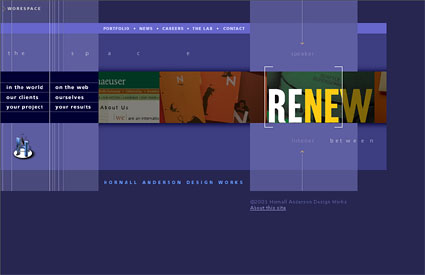
HADW’s Web site offers up an abundance of information about the design fim. It’s also a worthy example of HADW’s design capabilities.
Much of what HADW does for clients on the Web follows the HADW expertise in branding. This design firm is known for establishing identities that move beyond products or services, and that infuse the cultural milieu with their presence. Peruse the lengthy HADW client list for the marks and established brands that resonate in our collective consciousness.
The Web challenge for HADW is tailoring a site that conveys each client’s story as clearly and memorably as possible. This also means meshing the content of the Web with a total branding program, from the unique identity to what’s on the retail shelf to the entire retail environment.
But there are some clients and some sites specifically tailored for a Web identity like Twelve Horses. However intriguing, the name of the firm does not immediately convey the business-to-business expertise it offers. HADW worked with the company to develop detailed graphics displays describing the company’s specialized services, namely allowing businesses to integrate traditional print with digital services, and to create a myth-influenced mark. The “legend” explains the origin of the company’s name and mission in motion graphics with a swelling soundtrack.
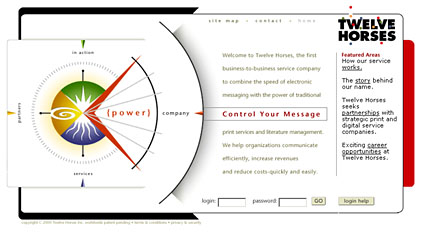
HADW worked with Twelve Horses to come up with designs that help reflect its business-to-business expertise.
According to HADW’s Jack Anderson, the Web-site challenge for another client — Mahlum Architects — was to capture of synergy of two firms coming together: Mahkum Nordfors, known for public architecture and classically conservative architecture, and McKinley Gordon, which was considered more innovative. Anderson relates that the intention of the combined businesses was to convey the natural, humanistic, organic underpinnings of the Mahlum approach. So the site focuses on the romance of space and the artistry of building. Here impressionistic Flash films and tracking typography, accessible through an organic navigational structure, subtly convey the Mahlum message. One animation presents the text “What makes a building beautiful?” as the sound of seagulls gently squawking rises in the background.
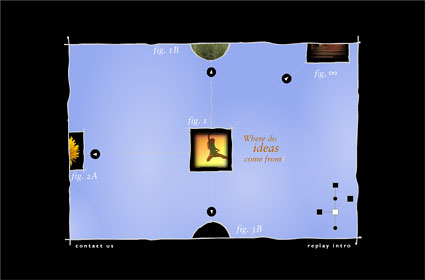
The expressive, flowing site HADW designed for Mahlum Architects focuses on the humanistic, organic aspects of Mahlum’s approach.
This article was last modified on January 8, 2023
This article was first published on August 20, 2001
Commenting is easier and faster when you're logged in!

Recommended for you
Find Change the Next Paragraph Style with a Script
I want to change all the paragraphs after a heading to have no indent... fortuna...
How to Keep the Book Panel from Disappearing in InDesign
A simple tip to keep the Book panel where you left it in InDesign

InQuestion: Automatic Table and Figure Numbering
Jamie McKee shows how to use defined lists to take the time and toil out of numb...