



A few weeks ago, I was sitting at the Denver International Airport waiting for the Super Shuttle when I suddenly saw myself as a dinosaur. How many times had I made this trip to Quark over the years? How many enthusiastic new faces had I shaken hands with while pledging to keep an open mind? And how many times had I returned even more jaded than before, thinking that it was only a matter of time before Quark got its comeuppance?
Yet I was looking forward to this particular visit. The crew at Quark has been much more consistent and impressive in recent years, and I’d been hearing good things about XPress 7.0. Plus, I know that no matter what the official company line is, Quark’s financials must be hurting from the release of InDesign and the apparent lack of enthusiasm among customers for recent upgrades. There’s nothing like a financial hit to foster innovation, and though Quark is nowhere near a make-or-break point, ice-cold water has clearly been thrown in its face. The company seems more awake and alert than ever. You may feel it’s too late, and for many of you it might be. But it’s naïve to suggest that what Quark does with XPress is not important.
Focusing on the detailed feature battle between QuarkXPress and Adobe InDesign is sadly misdirected — that’s a little like arguing which company makes better film, Kodak or Fuji. Opportunity for publishers and designers isn’t going to come from expanded transparency settings or hanging punctuation. Page design and production is, in most cases, still a painfully manual process that sits outside of mainstream data flow. That was fine when publishing was a one-way, marginalized process, but now it just creates bottlenecks and aggravates the IT department. With XPress 7.0, Quark is making a major commitment to move page production out of its proprietary and dead-end world. That may not be something designers can sink their teeth into, but it’s good news to production and IT managers at large companies around the world.
Oh, and by the way, Quark is also adding transparency settings, better typography, and enough bells and whistles to please all but the most aggressive feature mongers. More on that on page 2 and 3.
Starting with a Clean Slate
There’s a lot to say about XPress 7.0, and for most users it’s worth waiting for, if only to evaluate. Quark understands that this is a critical upgrade and knows that our collective patience is running out. Consequently, this isn’t a case of tacking on a few new features to XPress. It’s about a wholesale makeover that, if it works, preserves the things that made XPress such a success, while still moving the needle toward collaborative, automated, and fully integrated publishing processes.
But before I reveal Quark’s strategy and some of the new features, let me explain why I’m giving Quark the benefit of the doubt and not qualifying every point with a “wait and see” statement.
- I don’t know if this is the “new” Quark, and I don’t care as much as I use to. In the last few years we’ve all been betrayed by trusted brands and learned the hard way that customer loyalty is a one-way street. We’ll buy a $30,000 car from a company we know nothing about, yet we get all emotional over a $900 software product. Quark has at least been consistent, even when dysfunctional, and hasn’t shifted resources to other products at the first hint of market decline.
- I sincerely believe Quark has addressed its customer service issues, and I’ve spoken to a number of users impressed by the change. If you are still holding a grudge against Quark for past deeds, it may be time to kiss and make up.
- I don’t like outsourcing any more than you do, but it’s a reality of global business. While Quark was a little early to shift jobs to India, there are engineers, programmers, and product managers in Denver who understand what their customers do, and those are the Quark employees calling the shots. XPress has been notorious for its complicated computer code, and I don’t think the ambitious changes in XPress 7.0 would be possible without a big team of programmers somewhere cheaper than America.
- Most people now working on XPress seem oblivious to the old ways of Quark and impress me as smart and sincere. The atmosphere in Denver these days is casual, open, and diverse — somewhat different than that of Adobe, a $1.5 billion corporation. The paranoia of the past seems to be in check, and all of my questions were answered with more detail than requested.
I won’t speculate on when XPress 7.0 will ship or if all the touted features will actually make it into the final release. All of the items I’m covering in this article have been demonstrated to me in working software, and I was free to sit down and play with 7.0 during my visit.
The Case for Open Standards
Quark has essentially re-written XPress from the ground up to add support for a slew of open standards and to make it easy for third-party developers to create never-before-possible custom features. I won’t bore you with the details, but suffice to say that Quark’s XML strategy seems compelling, and with a little imagination you can easily envision XPress 7.0 hastening the arrival of true cross-media, automated page production that integrates well with enterprise data systems. Those of you who design one-off brochures and business cards may be nodding off right about now, but keep an open mind — some of these things will benefit every user.
Adobe InDesign has an open XML strategy as well, and both companies have embraced XML as the link between page-layout and other forms of information publishing. But with the huge installation of XPress worldwide, I think Quark’s actions have a better chance of moving the ball more quickly forward in the quest for XML-based publishing workflows.
QXML, the new Document Object Model in XPress 7.0, will eventually give developers industry-standard read and write access to all XPress page content, including formatting, style sheets, and hyphenation and justification specifications. This will, hopefully, mean that the values we place on design and formatting aren’t lost in an automated, data-driven publishing model. A lot of high-volume page production is outsourced to India and China, where companies are building very advanced publishing systems. To deal with this new reality, the creative community has to get out of production mode and focus on the value of design (which is now stuck in native file formats). I think much of what Quark is doing will not only preserve, but could even expand the contribution designers make. But we have to face that no one wants to pay designers to crank out volumes of individual pages. That’s going to have to happen on the fly.
By implementing a JDF-compliant Job Jacket system in XPress 7.0, Quark is stimulating better and more efficient interaction between publishers and its production partners. Again, it’s hard to get all hot and bothered about something like a job jacket, and this is one of those features that may take some time to appreciate. Quark can’t force all the benefits to manifest themselves — it can only create the container and hooks for others. But you can imagine the potential benefits when an XPress job carries a huge amount of standard information with it that defines parameters and intent and has approval and contact information, output specifications, and a host of other information, all of it easily accessible to both people and production systems. Your printer can, for example, send you a Job Jacket that has all the output settings pre-configured to the press and paper your job will run on. Then you can soft-proof it to your screen based on that data, and when you go to make the PDF files, they’ll be done directly to the printers’ specs. Quark Job Jackets should move us even closer to a time when jobs move through the production process with little human intervention, which is the only way we’re going to cut costs and hasten time to market.
Quark is also supporting the Personalized Print Markup Language (PPML) in XPress 7.0. PPML creates a standard way to handle variable data in XPress pages. It isn’t completely clear that PPML will be the solution to variable-data publishing, but it’s a reasonably safe bet, and all we have right now. The slow adoption of on-demand digital printing is partly because it’s not that easy to merge a database of information with highly formatted page composition. Built-in PPML support opens the door a little wider for those designers and marketing folks who recognize that personalization is an important service to offer.
And though I suppose this may fit better under the “improved typography” category, XPress will now support the most common (though not all) OpenType features and is now Unicode compliant. This is clearly late, but there it is.
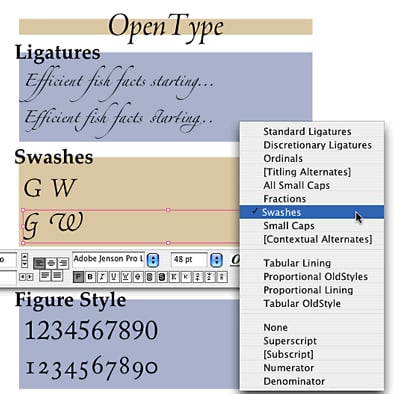
XPress 7.0 will support 23 of the most popular OpenType features (slightly less than in Adobe Creative Suite). You will be able to mix languages in the same paragraph in XPress, and spell check in multiple languages.
This article was last modified on June 30, 2023
This article was first published on July 25, 2005
Commenting is easier and faster when you're logged in!

Recommended for you
Adobe InDesign Released for iPad, iPhone, and iOS
It's the answer to a prayer, says some users (it's the end of the world, say oth...
Customizing Keynote’s Toolbar
Spending a few minutes to customize the Keynote interface to your liking can sav...

Checking Color Contrast for Accessible Design
How to use tools like WebAIM Contrast Checker, PageProof, and Stark to ensure yo...