

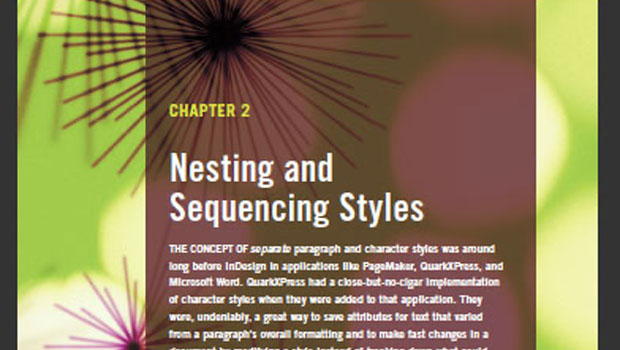
Get the Nesting Instinct: InDesign's Nested Styles Auto-Format Multiple Paragraphs

Before InDesign CS, no page layout program allowed character styles to work within paragraph styles. The two styles were completely independent of one another. But now you can prebuild one or more character styles into a paragraph style and trigger those character styles with specific conditions; e.g., bold the beginning text in a paragraph until an em dash appears. What character styles are nested in the paragraph, in what order, and what triggers the switch between them, is entirely up to you!
Written by Michael Murphy on June 8, 2009

Related Reading

This article is excerpted from Adobe InDesign CS4 Styles: How to Create Better, Faster Text and Layouts, published by Adobe Press.

The concept of separate paragraph and character styles was around long before InDesign in applications like PageMaker, QuarkXPress, and Microsoft Word. QuarkXPress had a close-but-no-cigar implementation of character styles when they were added to that application. They were, undeniably, a great way to save attributes for text that varied from a paragraph’s overall formatting and to make fast changes in a document by modifying a style instead of tracking down what could amount to hundreds of local overrides. But that’s as far as it went. The two styles—paragraph and character—were completely independent of one another. In other applications, character styles still had to be applied one by one to any text that required them.

With InDesign CS, Adobe’s engineers did something that, it seems, had never occurred to anyone before: They made character styles work within paragraph styles using a feature called Nested Styles. This concept was so simple, and it made perfect sense. How had someone not thought of it before?

In the simplest terms, the Nested Styles feature is a way to prebuild (or nest) one or more character styles into a paragraph style. Those character styles are automatically applied in a predetermined order that is “triggered” by specific conditions (e.g., “through 2 commas” or “up to 1 En Space”). What character styles are nested in the paragraph, in what order, and what triggers the switch between them is entirely customizable.

Nested styles are appropriate for any project. For large jobs like directories and catalogs with great quantities of text or cyclical publications like magazines and newsletters where a look and feel is established in advance and reused month to month, they are the best way to improve productivity, ensure consistency, and maintain the highest level of flexibility throughout the design and production process. While they may be less critical for smaller or stand-alone projects like advertisements and packaging, they are no less useful.

This entire series of paragraphs was created with prebuilt styles.
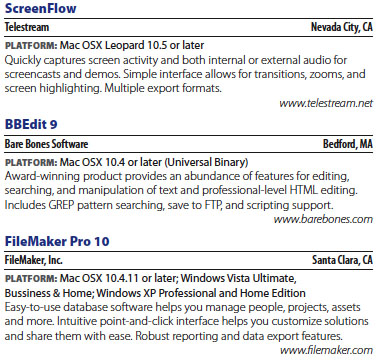
To learn how to make nested styles work best for you, download the PDF by clicking the image below.

Excerpted from Adobe InDesign CS4 Styles: How to Create Better, Faster Text and Layouts and used with the permission of Adobe Press and Peachpit Press.

1

oh oh

Downloaded the PDF to my Windows machine and the message indicates its format can't be read!

2

PDF is readable on Windows

I'm able to open the PDF in Adobe Reader 7.0 on a Windows machine running XP. What version of Acrobat are you running?

Terri Stone
Editor in Chief, CreativePro.com

3

Can't download pdf

I have Windows XP 64 - files stalls my browser and won't download. Usually I don't have any problem with pdfs from your site or anywhere else. Is something wrong with this pdf?

4

PDF problems? Try downloading again

Five people were able to open the PDF without any issue on Window XP machines running Acrobat 7 or later and Adobe Reader 7 or later. So I think the file itself is OK.

However, it is a BIG file -- 26MB! I suggest downloading it again in case it was corrupted during transfer.

Terri Stone
Editor in Chief, CreativePro.com

5

Character styles as function of para style before Quark

You say that InDesign is the first to have character style sheets automatically applied to certain type within a paragraph style. I would like to point out that FrameMaker had this option -- though in a much more limited form -- before Quark had character styles at all. Granted Quark had character styles through an xtension in Quark 3, but it was not until Quark 4 in 1997 that they were built into the program.

FrameMaker had character styles in Frame 2 in 1987, and the option to have them automatically applied through the auto-numbering option in Frame 5 by 1995, and probably in Frame 4 by 1993 (I don't have a copy of 4 to check). This character style would only be applied to the auto-numbered part of the paragraph, but it was there nonetheless.

I will admit that the implementation in InDesign looks far beyond anything else available out there, but Adobe had a program with the germ of the concept very soon after Quark first included character styles at all. I am still shocked at how primitive Quark's character styles were as of Quark 7.

6

One of the big challenges of

One of the big challenges of any project is figuring out how to maximize your time and get the best result. When the project is creating a layout in InDesign the solution to that challenge is the proper use of styles. Whether character, paragraph, or object, advice on getting them all to integrate nicely together can be a bit daunting even for the most experienced designer.

Post a Comment

  • Allowed HTML tags: <a> <em> <strong> <cite> <code> <ul> <ol> <li> <dl> <dt> <dd> <p> <div> <br> <center> <img> <h2>
  • Lines and paragraphs break automatically.
  • Use <!--pagebreak--> to create page breaks.

More information about formatting options

CAPTCHA
This question is for testing whether you are a human visitor and to prevent automated spam submissions.
Image CAPTCHA
Copy the characters (respecting upper/lower case) from the image.