


The Ins and Outs of ISO


This article courtesy of the Adorama Imaging Resource Center’s “100 in 100” series of tips.
This article explores the many ways in which ISO–your camera’s sensor’s sensitivity to light–affects your images.
Part 1: Understanding the Effect of ISO on Exposure
Think of ISO as a worker bee. If my camera is set for ISO 100, I have 100 worker bees; if your camera is set for ISO 200, you have 200 worker bees. These worker bees gather the light that comes through the lens and make an image. If both of us set our lenses at f/5.6 so the same volume of light will be coming through our lenses, you will record the image the quickest, since you have twice as many worker bees.
How does this relate to shutter speed? Let’s assume we’re photographing a flower on an overcast day. For you, 1/250 sec. is correct, but for me, 1/125 sec.–a longer exposure–is indicated.
Get out your camera and a pen and paper. Set your ISO to 200 and your aperture to f/8. Point at a subject and adjust your shutter speed until a correct exposure is indicated. Write down the shutter speed. Now change to ISO 400, leaving the aperture at f/8, and point the camera at the same subject. You’ll see that your light meter is indicating a different shutter speed for a correct exposure. Write it down. Repeat at ISO 800 and 1600.
What have you noticed? When you change from ISO 100 to ISO 200 your shutter speed changed: from 1/125 sec. to 1/250 sec. or perhaps something like from 1/160 sec. to 1/320 sec. Each shutter speed is close to if not exactly half as much as the one before it.
So, going from 1/125 sec. to 1/250 sec. is half as long an exposure time. When you set the ISO to 400, you went from 1/125 sec to 1/500 sec. Just as each halving of the shutter speed is called 1 stop, each change from ISO 100 to ISO 200 to ISO 400 is considered a 1-stop increase (an increase of worker bees).
You can do this same exercise just as easily by leaving the shutter speed constant, for instance at 1/125 sec., and adjusting the aperture until a correct exposure is indicated in the viewfinder; or, if you choose to stay in autoexposure mode, select shutter-priority, set a shutter speed of 1/125 sec., and the camera will set the correct aperture for you.
ISO in Action
In all five of these shots of my daughter flying towards me, I used the same action-stopping shutter speed of 1/250 sec. with my Nikon D200 but used a different ISO and, subsequently, a different aperture in order to keep the exposure constant. As my ISO increased, so did the visual flaws (increased noise and, in this case at least, some unwanted increase in depth of field).
ISO 100
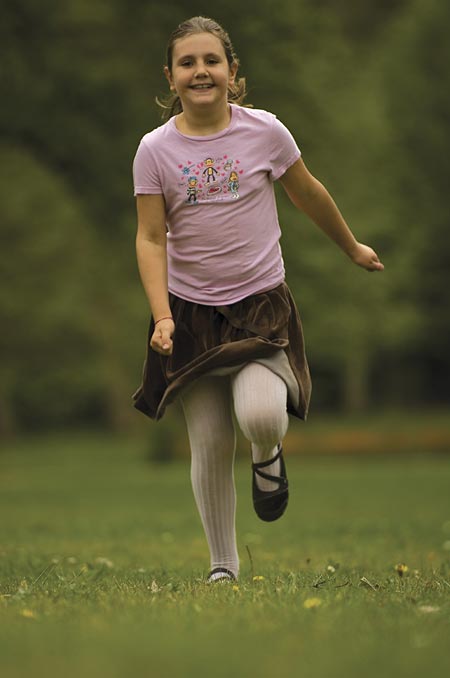
ISO 200

ISO 400
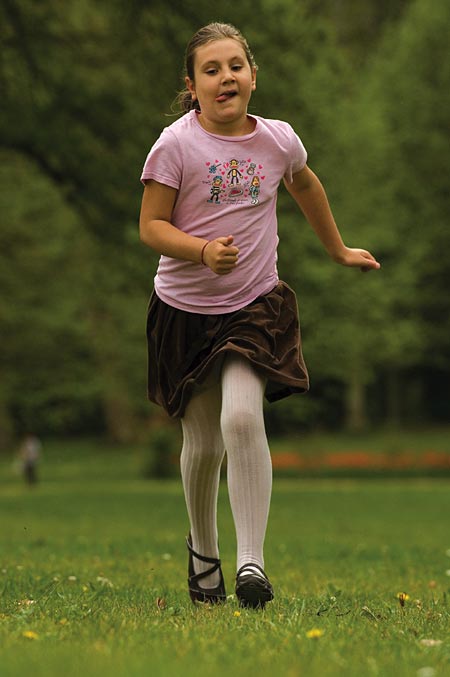
ISO 800
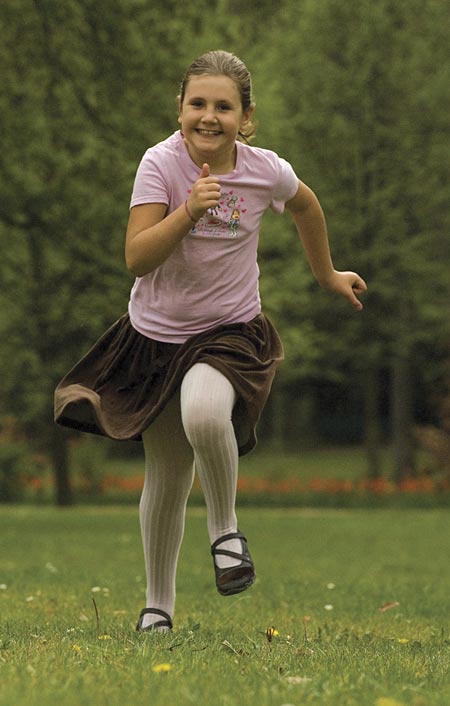
ISO 1600
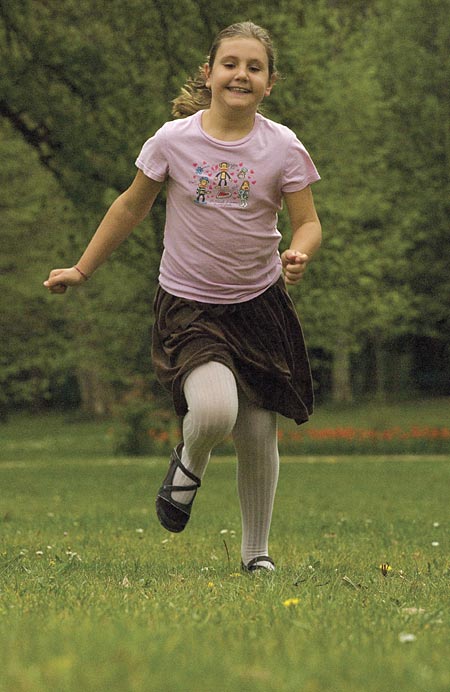
In the first image note the out-of-focus tones that surround her. The exposure was ISO 100 at an aperture opening of f/4 for 1/250 sec. Note how the area of sharpness around her increases as the ISO gets higher. You can see it clearly in the grass both in front and behind her foot and also in the background, which becomes more defined. In addition, the use of ISO 1600 really brings on the noise!
Part 2: The Myth of ISO Exposed
Most of those fleeting moments you want to photograph can be captured at shutter speeds that are well within your reach–even when you use ISO 100. The need to use a high ISO (for example, ISO 400, 800 or even 1600) just because you want to freeze the action before you in exacting sharpness is a myth! Yes, camera manufacturers are making some great strides in noise reduction. In particular, Canon and Nikon, the two industry heavyweights, have several digital camera models that deliver some truly low to moderate noise levels at the high end of their ISO spectrum, from 800 to 2400.
But with the promise of fine grain at these high ISOs its easy to become seduced and some of you might even think that you can now say good-bye to your tripod–yikes! Here’s why you shouldn’t be seduced by High ISO’s.
In action photography, if you expect to record–in exacting sharpness–the power of an ocean wave slamming hard against the rocky cliffs or a motocross racer flying over the rain-soaked hill, you will need all the ISO sensitivity you can get, right? Wrong! Just because ISO 400 lets you use a shutter speed that’s twice as fast as ISO 200 and four times as fast as ISO 100, it doesn’t necessarily mean the quality is better. Why? As you increase sensitivity, overall image quality gets worse.
Noise, also called grain, begins to be a real problem in DSLRs whenever you use a high ISO such as 640, 800, and beyond. Grain affects overall sharpness and even color and contrast. In addition, at higher speeds you often end up using smaller lens openings, which, increases the overall depth of field (sharpness from front to back) and this, in turn, makes the noise that much more apparent. And even if your camera promises noise reduction, the increased depth of field could introduce too much distracting background detail.
ISO 100 action: With my tripod mounted Nikon D2x set to 100 ISO and my Nikon 70-200mm f/2.8G lens set to f/8 at a 1500 second, I froze the waves pounding on the rocks and still had enough depth to get the Golden Gate Bridge in the background. In this case, I wanted depth of field and got it at f/8, but at ISO 100 I was also assured of optimal overall image quality.

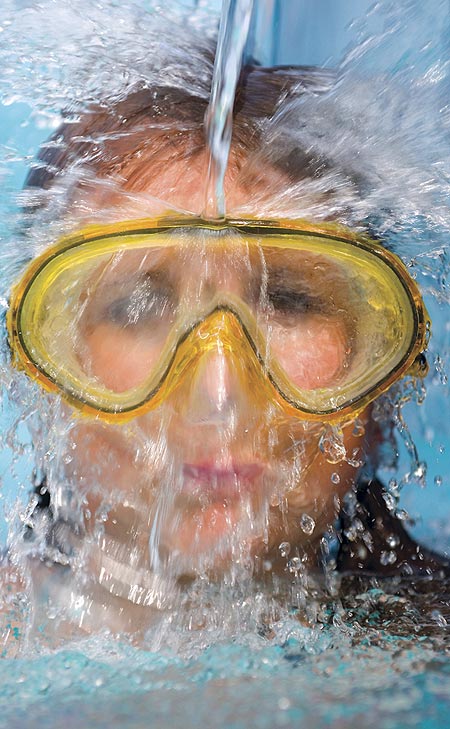
ISO 100, again! At a pool in Cancun, Mexico, my daughter posed under a small waterfall that sent down a gentle cascade of water into the pool. Hand-holding my Nikon D2x and Nikon 70-200mm f/2.8G lens, and with the ISO set to 100, shot this at 1/250 second and f/10.
Go to the next page for “Part 3: Freezing Action at ISO 100, 200, and 400”
This article was last modified on January 5, 2023
This article was first published on December 15, 2008
Commenting is easier and faster when you're logged in!

Recommended for you

Thoughts on the Sony A6000 Mirrorless Camera
Mirrorless cameras have been both a hot topic and a subject of some debate. Duri...
100 Most Important Cameras in History
If you didn’t get exactly what you wanted for the holidays, here’s a treat you c...
Review: Canon EOS M
Shutter noise in E flat major I photograph musical events in my community, speci...