





This is the absolute truth: Creative Paper takes great care to collect super-fresh sheep poo from the rainy mountains of rural Wales and take it back to the mill in southern Snowdonia (Figure 1). A new grade of paper begins with only the very finest materials, and they make other papers using waste paper, rag and textile off-cuts, and just about anything else that has good length cellulose fibers in it. They don’t use trees — they say they like trees. But they do use sheep poo.
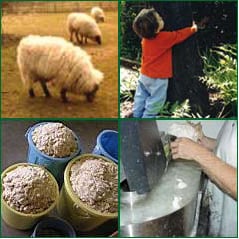
Figure 1. Scenes from Creative Paper’s papermaking-process. Note the tree-hugging child.
The sheep poo is sterilized by boiling it in a specially designed pressure cooker at over 120º centigrade (using only the purest Welsh mountain water, of course) and then washed repeatedly over a period of days until it has lost approximately half its original weight. A sheep only digests 50 percent of the cellulose fibers it eats. Why you need the purest water I am not sure.
The washing process produces a pile of usable fibers and, as a by-product, it also produces a clean, sterile, rich, liquid fertilizer which they store in a tank at the mill and pass on to local growers. It takes many hours to beat the cellulose fiber until it reduces to a pulp suitable for making paper. This process is a closely guarded secret. The Chinese are said to be interested in paper made from yak poo. Using only traditional papermaking techniques, they form the pulp into sheets using special sieves (called a “mould and deckle”) and lay them out in stacks using felt in between each sheet to keep them from sticking together.
The stacked and felted sheets are then pressed under huge pressure to remove most of the remaining water and encourage the cellulose fibers to bond at a molecular scale to give the paper its strength. Hanging the paper up in the roof rafters of the mill to season them finishes off the drying process (Figure 2).
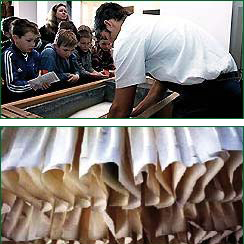
Figure 2. A Creative Paper employee demonstrates his craft to the kiddies (top). In the bottom image, sheets of paper hang from the rafters.
This paper is perfect for junk bonds (as Scott Tilden opined) and ideal for notes to people you dislike. Nothing says distaste like paper made from poop. So far, digital versions for inkjet and toner are not available. And if they can make ink from soy, why not use sheep poo? Poopink?
Dental Hygiene in Hi-Fi
And now for something completely different: iTeeth.
Hasbro scientists have invented a toothbrush that lets you listen to music while you scrub your teeth by transmitting the sound waves through your teeth and jawbone to your ear. The under-$20 device, called Tooth Tunes, plays for exactly two minutes, the amount of time dentists recommend for brushing every morning and evening. It is initially being targeted at children, but could also be marketed to the iPod generation.
Hasbro claims that Tooth Tunes will “single-handedly change children’s attitudes” to brushing and expects it to be in stores before Christmas. A single piece of music is stored in a microchip in the brush’s handle. When a button is pushed, it plays on a minicomputer and is transported along the bristles, through the teeth and jawbone and into the ear. It is truly wireless, unless you have braces, and then you can broadcast on certain FM channels. While the user hears “a cross between the sound of music coming out of a stereo and the sound of humming to oneself,” onlookers sense a buzzing noise similar to an electric toothbrush — or in some parts of the world, a crank toothbrush.
Replacement chips with different songs will be available, and Hasbro is negotiating with the Black Eyed Peas and Will Smith. The firm spent years trying out its new technology in lollipops, pens, spoons, and forks before launching it in toothbrushes.
One of the inventors said, “The human jaw is a great conductor of sound.” In Britain, the Department of Health says that the number of under-fives having rotten teeth removed has soared by 20 per cent in recent years, with many having all 20 milk teeth removed.
Which leads me to a story about the difference between selling and marketing.
A toothbrush company once introduced a new toothbrush. Salespeople stood on street corners hawking the new dental device, but there were few buyers. One salesperson filled a dish with sheep poop and offered free chips and dip. People rushed for the free munchies and took a bite. “That tastes like crap,” they exclaimed. “Wanna buy a toothbrush?” asked the salesperson.
No, You Can’t Go Back to…Enovation
Say farewell to Enovation and hello to Fujifilm. In October, Enovation Graphic Systems Inc. is changing its name to Fujifilm Graphic Systems USA. The name change is in conjunction with the worldwide name change of parent Fujifilm Holdings Corp. (formerly Fuji Photo Film Co. Ltd.).
To the tune of “Istanbul was Constantinople,” with apologies to the Four Lads:
Fujifilm was Enovation
Now it’s Fujifilm, not Enovation
Enovation is the one that’s all gone
And Fujifilm Graphic Systems carries on
Every printing buyer of Enovation
Now buys their stuff from Fujifilm
So if you need a plate from Enovation
Use the latest naming innovation
Call those folks at Fuji’s corporation
But Enovation was once called Fuji Photo Film
And then they changed to Enovation
Now they changed it into Fujifilm
They keep going back and forth
Just call it Fujifilm henceforth
Even Kodak Graphic Communications was once called Polychrome — well, also Anitec, Imation and even KPG
Why they changed it I can’t see
Maybe it looks better on a Graph Expo marquee
So take me back to Enovation
No, you can’t go back to Enovation
It’s really gone, Enovation
Why did Enovation go back where it first began
That’s nobody’s business but some guy in Japan
This article was last modified on January 10, 2022
This article was first published on October 2, 2006
Commenting is easier and faster when you're logged in!

Recommended for you

Pantone Smoothies: The Ultimate Designer’s Drink
I’ll take “Stuff You Can’t Make Up” for a thousand, plea...

Heavy Metal Madness: Printing and the Interior Designer
We’ve been doing some minor remodeling at our house recently, so my wife P...
A Question of Character: Finding What You Need in Your Fonts, Part 2
In the previous installment of this column, I talked about the first generation...